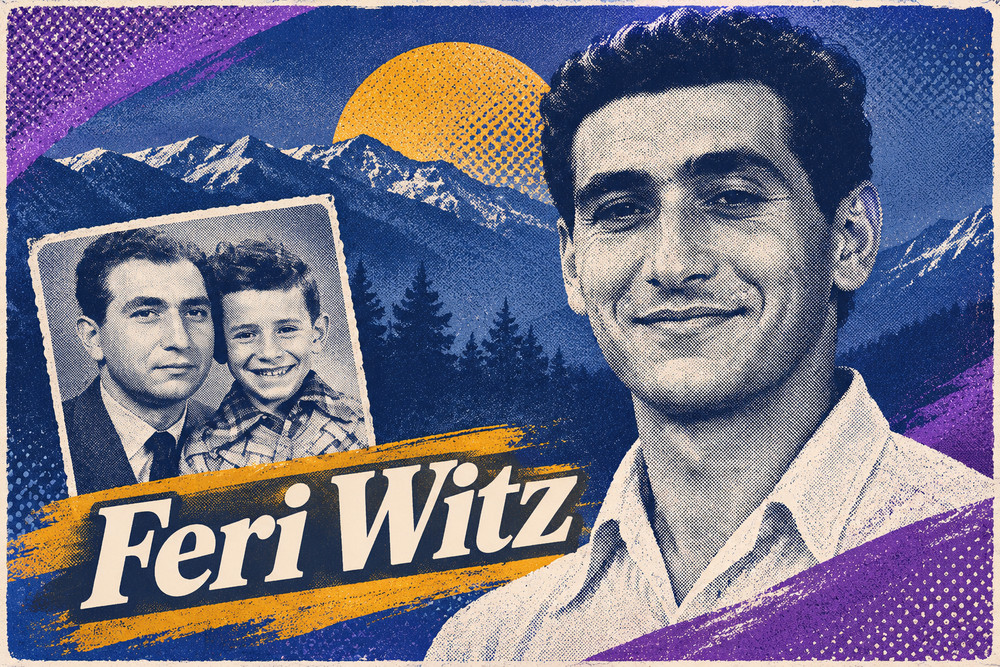
A Letter Read at the Grave
At a cemetery in Israel in March 2011, Gene Simmons listened as a sibling read an unmailed letter attributed to his father, Feri Witz. The visit came too late for a conversation between them. Feri had died in 2002, and Gene said he had not seen him since childhood.
Gene said Kaddish with relatives present and spoke regretfully about his decision never to visit while his father was alive. The scene aired on Gene Simmons Family Jewels on 28 June 2011. For a musician accustomed to commanding a stage, this was an encounter with something his success could no longer change.
The letter offered a different view of the absent father. Its writer described speaking six languages and being strong in mathematics and physics. War in Europe, recurring war in Israel, and personal tragedies had, he felt, prevented him from fulfilling his abilities. He nevertheless expressed pride in his children and pleasure in Gene’s happiness. I am moved by the gap between that account of frustrated ambitions and the pride he still attached to his children.
| Date | Event |
|---|---|
| 1958 | Flóra took Chaim to Queens, New York, while Feri remained in Israel. |
| 2002 | Feri had died in 2002, and Gene said he had not seen him since childhood. |
| March 2011 | At a cemetery in Israel in March 2011, Gene Simmons listened as a sibling read an unmailed letter attributed to his father, Feri Witz. |
The Carpenter in the Haifa Area
Feri was a Hungarian Jewish carpenter, also known as Ferenc Yehiel Witz. Yechiel and Yeichel are alternative spellings of his Hebrew name; Feri is a familiar form of Ferenc. He was born around 1925.
Carpentry is the occupation associated with him. The interests described in the letter suggest aspirations that reached outside his trade, although they do not establish a separate scientific or academic career. His own apparent disappointment concerned possibilities he believed had been closed to him.
By August 1949, Feri and his wife, Flóra Klein, were living in the Haifa area. Their son Chaim Witz was born on 25 August that year. He was the couple’s only child together, a distinction that would become important as Feri later formed other relationships and had more children.
Flóra and the Childhood Before New York
Flóra was born Kovács in Jánd, Hungary. She survived the Holocaust and was liberated from Mauthausen on 5 May 1945. Her brother Larry Klein survived too. Feri’s wartime circumstances are less clearly established, and Flóra’s imprisonment cannot be assumed to describe his experience.
Their marriage is usually dated to 1946. Where they married and exactly when they migrated remain unsettled. The firm point in their shared chronology is their presence near Haifa before Chaim’s birth.
Gene’s memories of those early years center on material hardship: a small stone house with one room, very little money, and no money for toys. He also remembered picking cactus fruit on Mount Carmel to sell. Those recollections describe a childhood in which earning even a small amount mattered. They do not identify a business run by his father.
The parents separated while Chaim was still young. In different recollections, Gene placed himself at six or about seven when Feri left. Whatever the exact date, he remembered the departure as abandonment, and the hurt remained part of his account long after he became famous.
Two Countries and an Uneven Correspondence
In 1958, Flóra took Chaim to Queens, New York, while Feri remained in Israel. She worked in a button factory. Larry, a baker in Flushing, belonged to the American circle that helped mother and son establish themselves. He was Gene’s maternal uncle, with no blood relationship to Feri.
Chaim used the names Eugene Klein and Gene Klein before adopting Gene Simmons. His career as a cofounder and bassist of Kiss eventually brought international recognition. Across that transformation, his relationship with his father remained unresolved.
According to Gene, letters arrived from Feri, but he chose not to answer. He said they never rebuilt a personal relationship. Once his career brought him money, however, he provided financial help for his father and children from Feri’s later marriages.
Housing was part of that assistance. Gene has described buying a house in some accounts and houses in others; the amounts and timing are unclear. He explained the support as an obligation to the man who had given him life. We can recognize the practical importance of that help without treating it as the reunion neither man experienced.
Flóra maintained a different connection. Gene recalled that she continued visiting Feri in Israel after the separation. Her continuing attachment and her son’s refusal of contact existed alongside one another, rather than following a single shared response to the marriage’s end.
Kobi Drora Sharon and Ogenia
Shannon Tweed helped arrange the gathering with Gene’s Israeli relatives during the 2011 trip. His longtime partner, she became his wife that year. The visit brought him together with four named children from Feri’s later family: Kobi, his half brother, and Drora, Sharon, and Ogenia, his half sisters.
Ogenia also appears as Oegenia and Eugenia. Gene had already met Drora in New York years earlier, so the Israeli gathering combined a reunion with new introductions. It was not his first encounter with every sibling present.
Feri married several times, but neither the marriage count nor the total number of children is settled. Gene’s descriptions have varied. The four siblings he named give a definite shape to part of the family without resolving every later relationship.
The Grandchildren on the Other Side of the Separation
Gene and Shannon’s children are Feri’s grandchildren: Nick Simmons, born on 22 January 1989, and Sophie Simmons, born on 7 July 1992. Whether either met their grandfather before his death is unclear.
Gene, Shannon, and Nick visited Yad Vashem during the 2011 journey, exploring the Holocaust history of Gene’s family. That visit addressed the persecution experienced by Flóra’s generation. The meeting with the half siblings and the cemetery visit concerned other parts of the same inheritance: relatives still living in Israel and a father whose death had ended the possibility of a personal reconciliation.
FAQ
What was Feri Witz known for?
He was a carpenter of Hungarian Jewish origin and the father of Chaim Witz, who became Kiss musician Gene Simmons.
Did Feri move to America with his son?
No. Flóra and Chaim emigrated to New York in 1958, while Feri continued living in Israel.
How many children did he have?
Gene, Kobi, Drora, Sharon, and Ogenia are named children. The complete number remains uncertain.
When did he die and did Gene see him again?
Feri died in Israel in 2002. Gene said they never reunited in person after the childhood separation. His later visit was to his father’s grave.