A Congressman With His Own Convictions
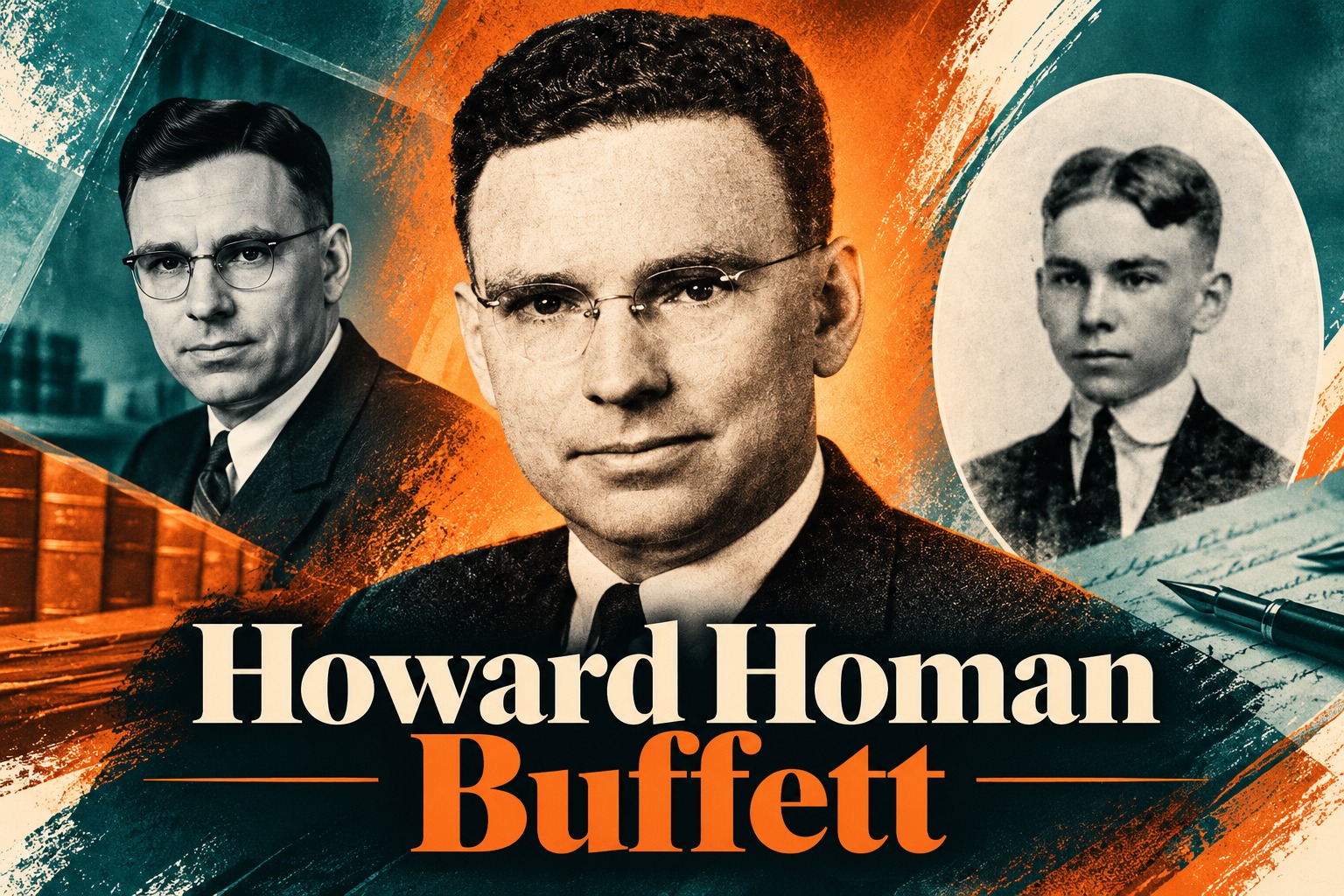
I regard Howard Homan Buffett as more than an introductory line in Warren Buffett’s biography. He was a stockbroker, a local civic figure, and a four term Republican congressman from Nebraska. His political positions concerning money and foreign policy gave him an identity distinct from his son’s later investing fame.
Howard was born in Omaha on August 13, 1903, and died there on April 30, 1964. The city remained central to his family and professional life, even when congressional service took him to Washington. His biography connects a local grocery business, securities work, public education, and national politics.
It also begins a useful exercise in distinguishing similarly named relatives. Howard Homan Buffett was Warren’s father. Howard Graham Buffett is Warren’s son, and Howard Warren Buffett belongs to the following generation. The shared first name connects the family across time without making these men the same person.
Ernest and Daisy Buffett
Howard’s father was Ernest Platt Buffett, an Omaha grocer who operated Buffett and Son. His mother was Daisy Henrietta Duvall Buffett, whose name also appears in the order Henrietta Daisy. Ernest lived from 1877 to 1946; Daisy lived from 1873 to 1921.
The grocery business places the family within a practical commercial setting before the later national reputation for investing. I find that background useful because a famous fortune can make earlier generations seem as though they always inhabited the same financial world. Howard’s parents belonged to a different stage of the family’s history.
Howard graduated from the University of Nebraska in 1925. He married Leila Stahl on December 27 of that year. These two events mark the beginning of his adult professional and family life, before his move into Congress.
Leila was born in 1904 and lived until 1996, outliving Howard by more than three decades. Their marriage produced three children: Doris, Warren, and Roberta. Those relationships form the immediate family at the center of his story.
Building a Securities Career
Howard entered the securities business and became associated with an Omaha brokerage generally known as Buffett Falk and Company. His work also extended to other local business interests. The occupation later became part of Warren’s early exposure to investing and commerce.
Howard worked in a smaller commercial setting and combined that work with public office. Warren’s later investing history belongs to another period and scale.
The connection is nevertheless concrete. A child growing up near a brokerage encounters a particular kind of business environment. Howard supplied that part of the family’s setting, while Warren later developed his own methods and professional relationships.
Omaha Education and the House of Representatives
From 1939 to 1942, Howard served on the Omaha Board of Education. This civic role preceded his national office and linked him with the city’s institutions as well as its businesses.
He won election to the House of Representatives in 1942, taking office on January 3, 1943. Reelection followed in 1944 and 1946. After losing in 1948, he returned through the 1950 election and served from January 1951 to January 1953. He did not seek renomination in 1952.
The interruption is part of the record. Four terms did not mean one uninterrupted eight year stretch. I find the actual sequence more interesting because it shows a political career that included defeat and a return, rather than a smooth ascent.
His congressional identity is often associated with the Old Right. He opposed interventionist foreign policy and criticized major foreign aid programs. He also argued against militarism and supported abolishing the draft. These positions placed limits on the international role he wanted the federal government to take.
Gold Redeemable Money and Political Ideas
Howard strongly supported currency redeemable in gold. His 1948 essay Human Freedom Rests on Gold Redeemable Money connected monetary arrangements with individual liberty. The argument continued circulating long after his congressional service ended.
I see the essay as a clear window into his priorities. Money, for Howard, was not only a technical concern of the brokerage business. It was connected to the relationship between individuals and government power.
That perspective explains why later libertarian and gold standard advocates returned to his work. It does not require accepting his arguments as settled economic truth. In a biography, the essential point is that these were convictions he expressed and defended, giving his public career a recognizable intellectual direction.
After leaving Congress, Howard returned to investment work in Omaha. His death in 1964 ended a career that had moved between business and politics while retaining the city as an anchor.
Doris Warren and Bertie
Doris Eleanor Buffett, born in 1928, became known for philanthropy with a direct personal approach. Her work included the Sunshine Lady Foundation, the Letters Foundation, and Learning By Giving. She died in 2020.
Warren Edward Buffett, born in 1930, became the family’s most widely recognized investor. His later leadership of Berkshire Hathaway and extensive philanthropy made his name internationally familiar. Roberta Buffett Elliott, known as Bertie and born in 1933, also developed a significant philanthropic role, including support for community health initiatives.
I find it useful that all three children’s public stories include giving, though their approaches and careers differed. Their adult achievements should not be attributed entirely to Howard, but they establish the family that followed his generation.
Among his grandchildren through Warren are Susan Alice Buffett, Howard Graham Buffett, and Peter Andrew Buffett. Susan pursued philanthropy, Howard combined farming, conservation, and giving, and Peter worked in music and philanthropy. Howard Warren Buffett is a great grandson, adding another distinct Howard to the family chronology.
FAQ
How was Howard Homan Buffett related to Warren Buffett?
He was Warren’s father. Howard and Leila Stahl Buffett had three children: Doris, Warren, and Roberta. Howard’s Omaha brokerage career formed part of the business environment surrounding Warren’s early life.
When did Howard serve in Congress?
He served from 1943 to 1949 and again from 1951 to 1953. He was elected as a Republican from Nebraska and completed four terms across those two periods.
Is Howard Graham Buffett the former congressman?
No. Howard Graham Buffett is Warren’s son and the congressman’s grandson. Howard Homan Buffett, the former representative, lived from 1903 to 1964 and belonged to the earlier generation.